Cool Hunters: The Legal Stalkers of South Culture
We are facing a text of Naomi Klein. The central idea of the text is the legal stalkers of youth culture. Cool hunters were paid by big corporations to make their image appealing to younger audiences. The text is divided in four paragraph. In each paragraph there is a different idea.
I totally agree with the writer of the text. I think that cool hunters are very dangerous because they spy on us in an absolutely legal way. They spy on us from the outside without knowing it ourselves.
The objective of cool hunters is to give advice on their products and advertising campaigns.
At the end of the text the writing says that back in the seventies "graffiti was like artillery fired in a war between the street and the establishment". I agree with Naomi when she says: with the passage of time graffiti has become in slave brand leaving anything unbranded.
Of all the videos I choose:
Forget shopping. Soon you'll download your new clothes
Why I must come out
Looks aren't everything. Believe me, I'm a model.
Grow your own clothes
The four videos that I have chosen are basically connected by fashion. Every video talks about it.
Fashion is a business that moves millions of dollars, is an industry that gives work to thousands of people and also enables the creation and enhancement of identities within societies.
In the first two videos are considered ways of creating clothes for a not too distant future. And in the last two videos talk about fashion from an emotional point of view: how advertising affects people and how to deceive us through photoshop and new technologies.
OPINION:
In the world of fashion there is only one value: money. To some extent it is necessary, because we have to dress, but they make us believe that we have to go to fashion and buy a lot of clothes. Big companies often talk about values and principles such as "we make clothes for a woman cosmopolitan and dependable of herself, but at the same time feminine" .... Normally the brands that expose their collections in catwalks invent the fashions, which are copied by cheaper brands
The brands try to convince you that in order to be beautiful you have to put on stupid creams and even operate. I do not say that fashion is bad, but the system is this.
Donald Trump walked slowly and 'stalked' Hillary Clinton during moments of debate. A decision probably driven by the stress of a stressful event.
Clinton was strategic in deciding to walk freely on the stage when he answered a question and put himself in front of Trump, which made him seem to be stalking her, because he had no where else to turn.
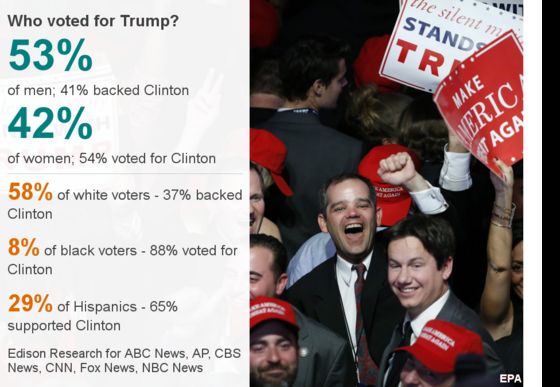
Reality Check: Who voted for Donald Trump?
 SUMMARY:
Donald Trump cattle Hillary Clinton in the race to be president of the United States.
It is very difficult to get a genuinely representative sample of how more than 120 million people have voted. It is a big survey - of almost 25,000 voters - and they are the best figures available, but they should be used with caution.
In the election there are a breakdown of voting by race and by age.
OPINION:
I try to find reasons why people vote for trump but I can not find one. I try to think of good things that can happen in your legislature but I can not even think of one. If you ask me bad things that can happen in your legislature I think I would not stop giving you reasons until tomorrow. I can only think of one reason why Americans have voted to Trump i is that the world is going crazy. With this reason you can also understand why the Spaniards have voted for our "dearest" President Rajoy.
VOCABULARY:
Nonetheless: Sin embargo
Poll: Encuesta
slightly: Ligeramente
http://www.bbc.com/news/election-us-2016-37922587
SUMMARY:
Donald Trump cattle Hillary Clinton in the race to be president of the United States.
It is very difficult to get a genuinely representative sample of how more than 120 million people have voted. It is a big survey - of almost 25,000 voters - and they are the best figures available, but they should be used with caution.
In the election there are a breakdown of voting by race and by age.
OPINION:
I try to find reasons why people vote for trump but I can not find one. I try to think of good things that can happen in your legislature but I can not even think of one. If you ask me bad things that can happen in your legislature I think I would not stop giving you reasons until tomorrow. I can only think of one reason why Americans have voted to Trump i is that the world is going crazy. With this reason you can also understand why the Spaniards have voted for our "dearest" President Rajoy.
VOCABULARY:
Nonetheless: Sin embargo
Poll: Encuesta
slightly: Ligeramente
http://www.bbc.com/news/election-us-2016-37922587
We've got human intelligence all wrong
 SUMMARY:
The human brain has nearly 100,000 times as many neurons as the bee brain, yet the rudiments of many of our most valued behaviours can be seen in the teeming activity of the hive.
About one-fifth of all you eat is used to power the electrical chit-chat between your 100 billion little grey cells. We can multi-task.
COMMENTARY:
Culture, technology, altruism and many other traits have all been touted as signs of human greatness – but the more you look, the narrower that list becomes. Macaques, for instance, have long been known to pick up stones to crack nuts while New Caledonian crows can craft hooks from a broken stick to help them pick up food - both rudimentary forms of tool use.
VOCABULARY:
lazily: Perezosamente
behaviours: Conductas
humpback: Jorobado
http://www.bbc.com/future/story/20161108-weve-got-human-intelligence-all-wrong
SUMMARY:
The human brain has nearly 100,000 times as many neurons as the bee brain, yet the rudiments of many of our most valued behaviours can be seen in the teeming activity of the hive.
About one-fifth of all you eat is used to power the electrical chit-chat between your 100 billion little grey cells. We can multi-task.
COMMENTARY:
Culture, technology, altruism and many other traits have all been touted as signs of human greatness – but the more you look, the narrower that list becomes. Macaques, for instance, have long been known to pick up stones to crack nuts while New Caledonian crows can craft hooks from a broken stick to help them pick up food - both rudimentary forms of tool use.
VOCABULARY:
lazily: Perezosamente
behaviours: Conductas
humpback: Jorobado
http://www.bbc.com/future/story/20161108-weve-got-human-intelligence-all-wrong
Fear of change.
Almost nobody likes change and many people prefer to forget what they really want rather than face any kind of change. However, the changes do not have to be for bad, on the contrary, they can bring you many good things (surely you remember an occasion when a change was for good).
On the other hand, human beings adapt to practically everything and is something to keep in mind, that we adapt to new things and start to consider them normal in a short time (and someone tells you who has changed city, country , And career).
TRIUMPH
What can be worse than failure? An imaginary triumph. After all, when you fail a project, you can try to reduce the consequences. Or if it is not possible, at least learn from the experience and work harder on the next try.On the other hand, an imaginary triumph can make us believe that we are on the right track, when in fact we are losing. And if we realize the error, it may be too late to correct it.Many people agree with this view. I'm sure if you do a survey asking yourself what it takes to succeed in life. The "Mucho dinero" option would be in place 20 in a list of 22. Among the first places would be health, get along with others and work on what one likes.For many of us it is easy to distinguish between actual and imaginary success ... at least when we are asked. But we may not be so clear about the difference in making decisions that affect our lives.
